


 Imprimir / Print
Woodpecker i-Sensor digital radiology sensor sensor
Easy-to-use, reliable and durable digital dental radiology sensor.
-
- 28-H2 sensor dimensions: 45 x 31.62mm (1,417 mm2.)
- Capable of generating high-quality images immediately (25 lp/mm)
- Multi-terminal installation: you can use and view from any terminal.
- Compatible with the main software on the market through Twain®
(See examples of management software compatible with Twain) - Not compatible with Apple operating system (macOS).
- Warranty: 24 months
Powerful software > High-resolution images
- 16-bit ADC chip brings 60,000+ grayscale in radiology.
- High-definition sensor with up to 2.2 million pixels.
- Powerful image processing functions:
- Faster and higher quality radiographic acquisition.
- More detail and better image quality with a resolution of 25 lp/mm.
- Clearer image effect, to easily find subtle bifurcations of the root apex.
Easy to use on any device
- USB 2.0 Connector.
- No external power supply required.
- Length of cable: 3m.
- One-click installation.
Extra-thin and curved-edged > sensor Increased comfort
- Ultrathin: 4,4mm
- Curved edges
Intraoral Digital Sensor: Reliable and Durable
- 80,000+ bending test
- Degree of protection IP68
Installation and initial support: at the expense of the distributor or the end customer. (RUMAR support if needed)
Examples of Twain-compatible® Management Software:
- Woodpecker® / DTE®
- * Carestream® – Dental Imaging Software
- * SATELEC® – AIS (ACTEON® Imaging Suite)
- * Kodak®
- * Gesden® (Through a Gesden® technician)
- * Romexis® (Planmeca®)
- * Gendex™ VixWin™ (except VixWin™ Platinum 3)
- * MyRay®
- * Sidexis® (Dentsply Sirona® | Version 4.1.1 or higher)
- * Durr®
- * Quickvision® (Through an Owandy® technician)
- * Odontonet®
- * Digora™ (Soredex®)
- * SOPIX 2® (ACTEON®)
*The aforementioned trademarks are registered trademarks that have no economic link with RUMAR,® Woodepcker® or DTE®.
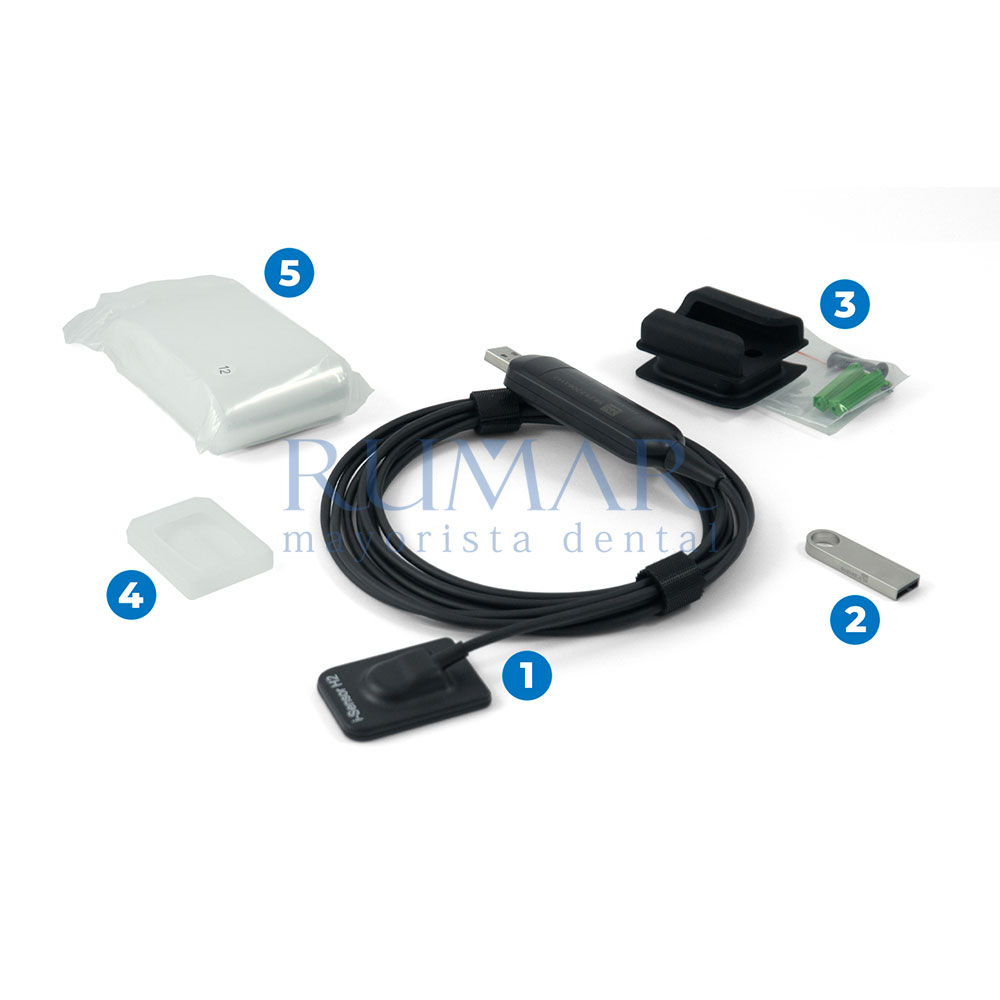
Supplies include:
- Sensor H2
- USB Installation Pendrive
- Attachment Kit
- Silicone protective case
- Disposable protective bags
**Discount category WP2
What are intraoral X-ray sensors used for?
Intraoral X-ray sensors are digital dental radiology devices that allow images of the inside of the mouth to be obtained quickly, accurately, and directly on the computer, enabling radiographic examinations that make it easier to assess teeth, roots, bone, and surrounding structures.
Among their main applications are:
- Caries diagnosis: they help identify interproximal lesions and other issues that may go unnoticed during a visual examination.
- Endodontics: they make it easier to visualize roots and root canals, as well as monitor treatments.
- Periodontics: they help assess the condition of the alveolar bone and supporting dental tissues.
- Implantology: they allow radiographic checks to evaluate bone structures and monitor implants.
- Conservative dentistry: they make it easier to assess restorations, fillings, and possible dental issues.
- Pediatric dentistry: they provide radiographic images tailored to the mouth size of younger patients, by selecting the appropriate sensor size.
Advantages of using digital dental radiology sensors
- High-quality digital images.
- Instant image display.
- Greater efficiency in daily work.
- Integration with radiology management software.
- Use across different workstations.
 BROCHURE ISENSOR | EN